
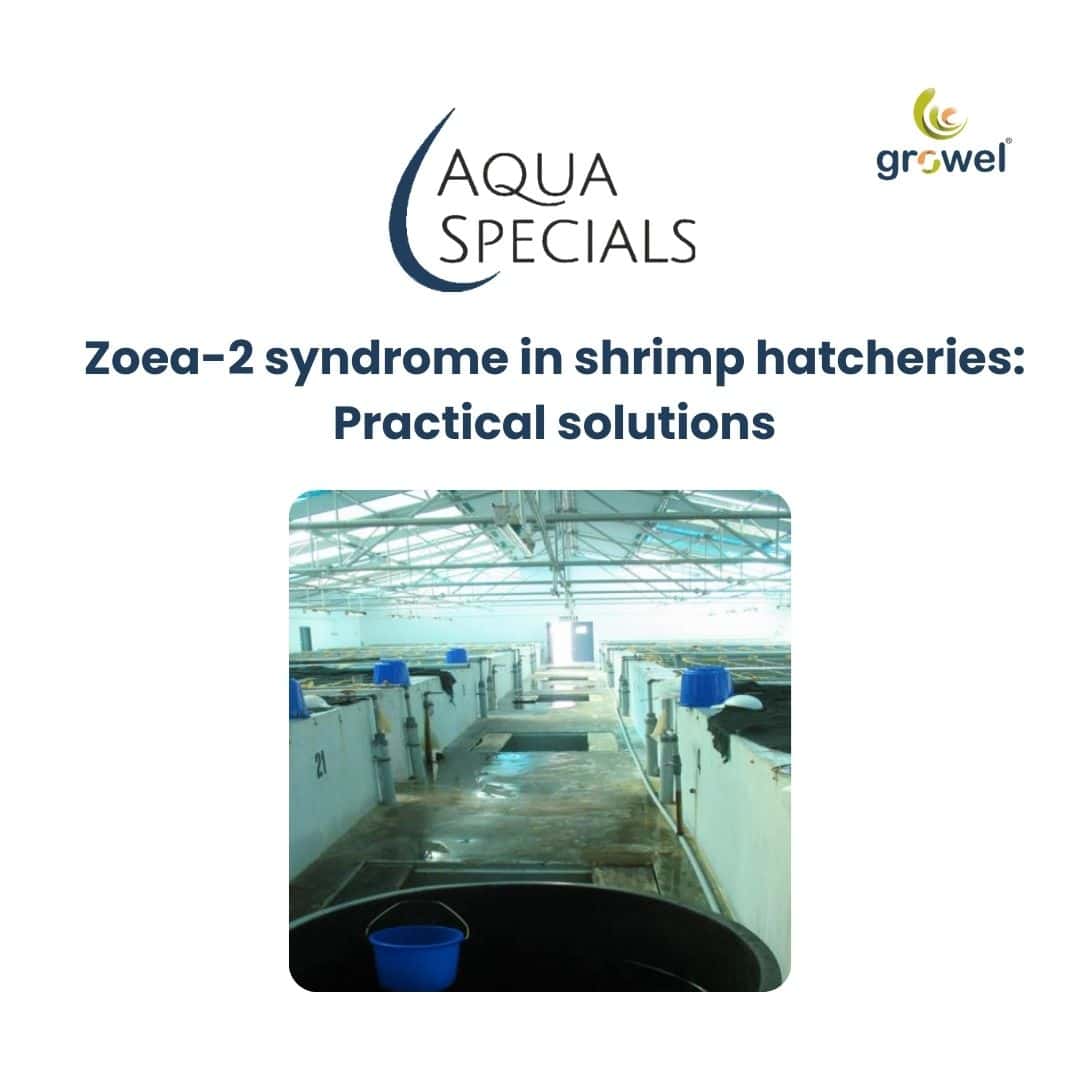
India’s shrimp sector is growing and becoming extremely dynamic and is dominated by the Pacific white shrimp (Penaeus vannamei),
Undisputedly the importance of high quality and healthy seed is the key to its success, but the increasing trend in intensification and commercialization of shrimp aquaculture to meet the demand has triggered diseases.
Zoea appear active and appear normal until they cross the Zoea-1 stage. Then they suddenly stop feeding after 36 – 48 hours and systemic abnormalities are observed, such as anorexia, lethargy, empty gut, reduction in feeding and absence of faecal strands, followed by delayed moulting of up to 3-4 days and gradual, progressive mortality in 30 – 90% of the larval population.
The following practical solutions are offered to control and mitigate huge losses from Zoea syndrome.
• Establishing strict management practices
• Stocking nauplii in less than 3 – 4 days in the same unit
• Disinfecting everything including Algae feed hoses, pumps, implements and air pipes
• Strict adherence to protocols in production and biosecurity
• Disinfection and complete hatchery dry-out after every production cycle
• Shutdown periods between larval production cycles.
• Isolating units for maturation, spawning and larval rearing could help reduce mortalities.
• Application of probiotics in water from Nauplii 5 /Zoea 1 stage.
Blogger:
Dr. Sathish Prasad
Senior Scientist – Aquatic Animal Health
Growel Innovation Center,
RS NO.57, Chevuru Village, Sriharipuram Panchayat, Mudinepalli Mandal, Krishna District – Andhra Pradesh India – 521329
Email: [email protected]