
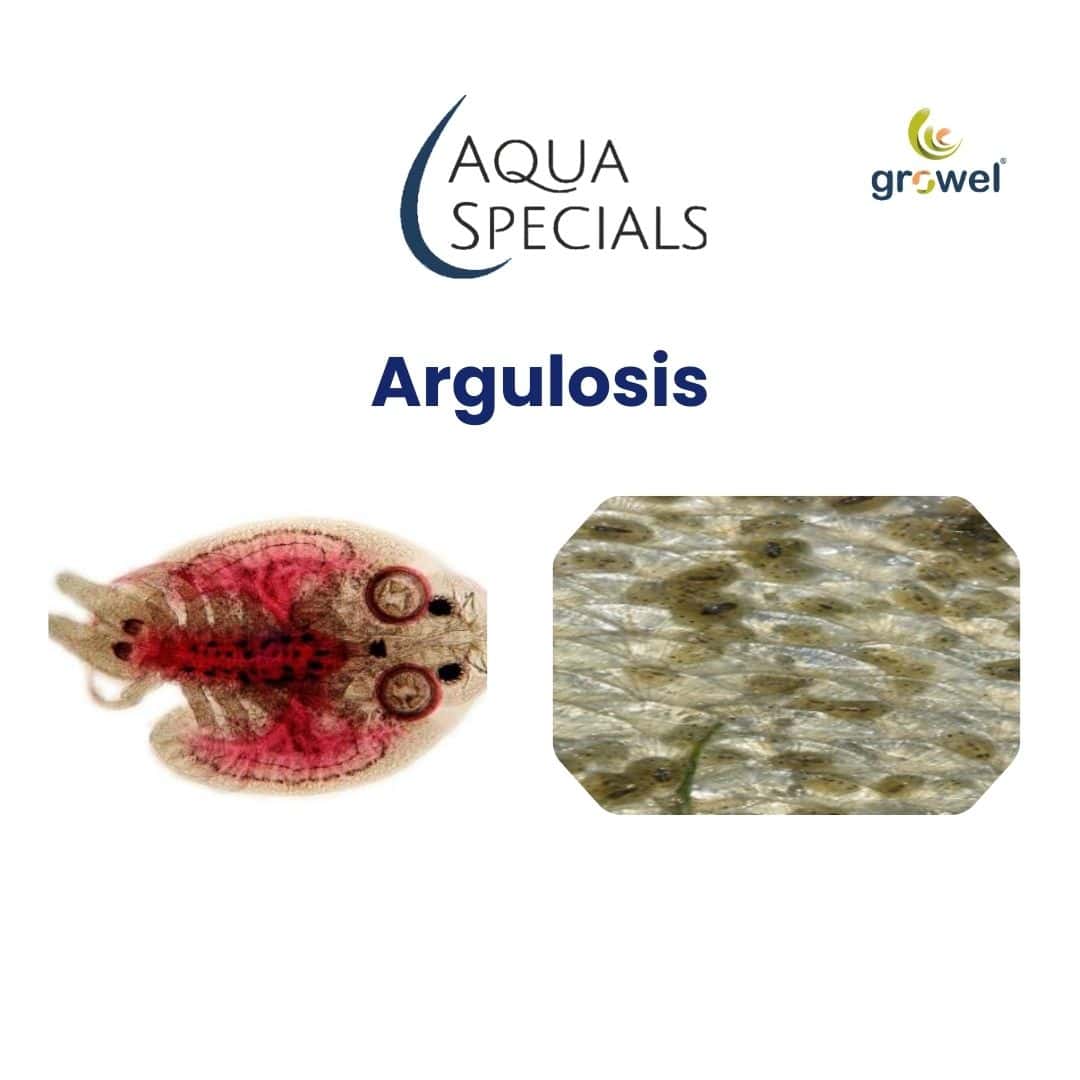
Argulosis is one of the major fish diseases commonly known as fish louse. The severity of this disease in India is well known as it can cause mass mortality in fishes, most often makes the fish morbid due to loss of blood that leads to weight loss and poor growth. The
haemorrhaged red or black patches on the body surface of the affected fishes causes them to have a blemished appearance. This is not preferred in the markets.
Pathogen: Argulus sp. (Argulus japonicus)
Target site: Skin
Species affected: The Indian major carps (Catla catla, Labeo rohita and Cirrhinus mrigala), contribute most to the total freshwater fish production in the country.
These species are found susceptible to the Argulosis disease, but L. rohita is the most susceptible as per reports.
Signs & Symptom:
– Bite lesion, open wound, Red spots, Dashing through water
– Affected fish have patches of hemorrhagic and edematous affected skin and fins.
– The parasite causes these injuries by attaching to the fish with its curved hooks and sucker.
-Argulus feed on the host’s blood and body fluids.
-The feeding apparatus also releases digestive enzymes which can cause systemic illness.
-They can cause significant morbidity and mortality.
Pathology: Necrosis, Loss of blood
Therapeutic measures:
• Common salt (NaCl) with 1.0%, 2.0% and 3.0% concentration.
• Potassium permanganate (KMnO4) with 0.025%, 0.05% and 0.1% concentration, respectively.
The investigations carried out recently have proved that 3.0% common salt’s solution for 5 minutes or 0.1% KMnO4 solution for 2 minutes as bathing medium can be used successfully to treat the fishes affected with the Argulus parasite.
It has also been reported in other studies conducted by researchers that bath treatment with 2.5% NaCl for 5 hours or 3.0% for 5 minutes or piperine at the rate of 9.0 ppm can cause complete elimination of the Argulus parasites from the carp fishes.
Prophylaxis:
• Disinfection
• Bamboo raft
• Maintain the healthy pond bottom.
• Remove the grass, vine/ floating plants in the pond.
Adherence to better management practices like proper water quality maintenance, stocking of healthy fingerlings which are free from such parasitic infestation, optimum feeding and manuring, liming, draining the ponds and drying the ponds at least once in three years, and application of prescribed doses of lime and KMnO4 intermittently in the ponds are the important precautionary measures to avoid the parasitic infestation.
Blogger:
Dr. Sathish Prasad
Senior Scientist – Aquatic Animal Health
Growel Innovation Center,
RS NO.57, Chevuru Village, Sriharipuram Panchayat, Mudinepalli Mandal, Krishna District – Andhra Pradesh India – 521329
Email: [email protected]