
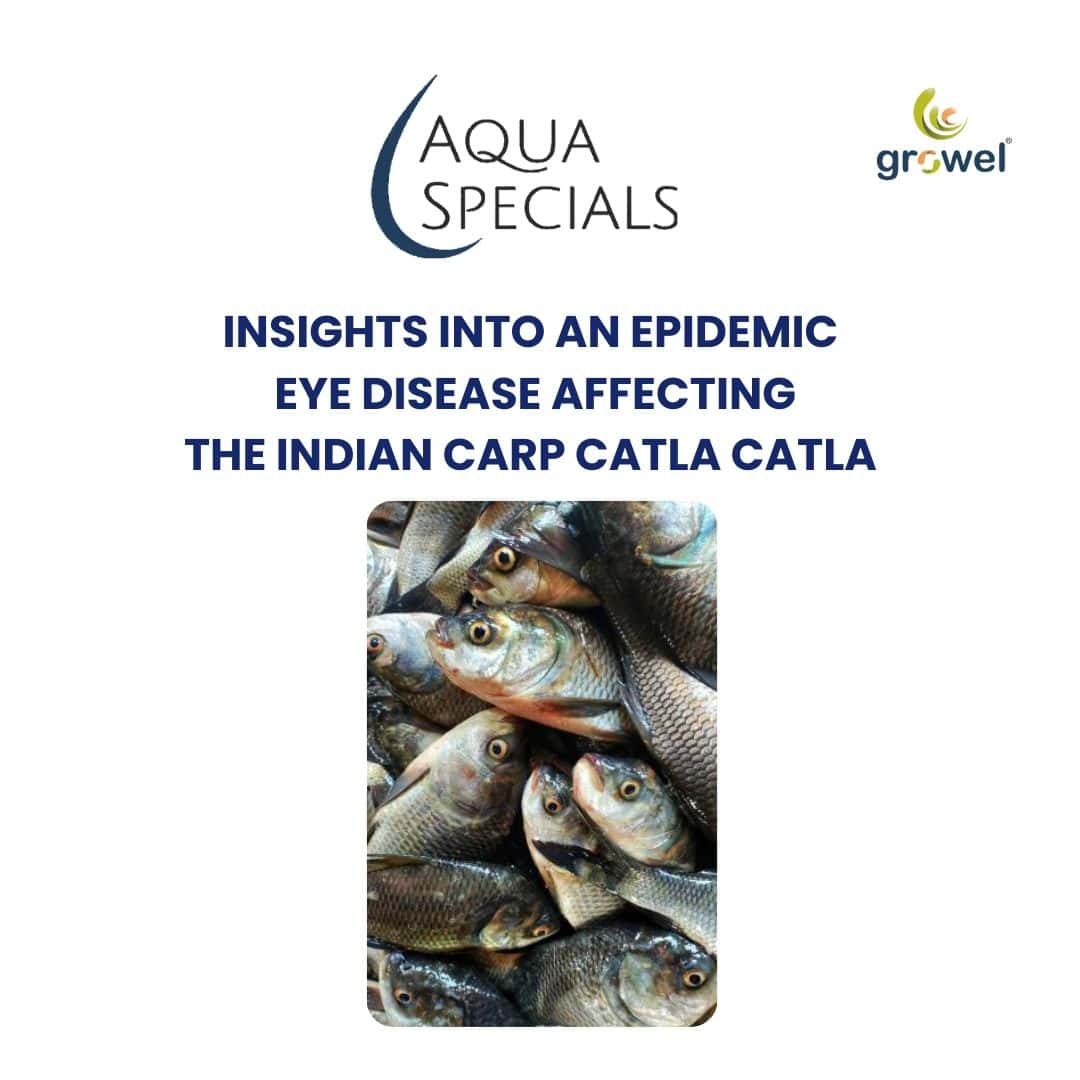
Catla catla is one of the major carps that is extensively cultured in West Bengal and adjoining States of India. The most important eye diseases of these fishes are ‘Exophthalmus’ or Pop-eye, Eye-fungus, Worm-cataract and Grey-cataract.
SYMPTOMS
• The primary organs affected by the disease are the eyes
of the fish.
• A reddish colouration develops in the cornea due to vascularisation during the early stage of the disease,
• There is no haemorrhage and it lasts for about 15 to 20 days.
• The cornea turns milky white in colour and becomes opaque following the vascularisation.
• The fish become lethargic and move near the water surface.
• Progressive infection results in putrefaction of eye tissues starting with the cornea and lens.
• In some cases, the opaque cornea gets punctured and the putrefied contents ooze out through the holes.
• Most of the fish at this stage of the disease die and float on the surface of the water.
• The infection spreads from the eyes to the brain gradually, through the optic nerves.
• All other organs of the fish are apparently unaffected by the disease.
• Death is rather prolonged, depending on the general condition of the fish and whether the infection started in one eye or both the eyes at the same time.
• Fish which contract the infection simultaneously in both the eyes die in about a week’s time after the cornea turns opaque, whereas for others the period may extend up to twenty days.
• On an average, death occurs within seven to twelve days after opacity of cornea takes place.
• Cultures prepared from the infected eyes, optic nerves and brain showed that the etiological agent of the disease is a bacterium, which has been identified as Aeromonas sp.
CONTROL MEASURES
• The fish with advanced infection is observed to rarely recover.
• Preventive measures to control the occurrence of the infection in epidemic proportions can be adopted in order to arrest its progress before the disease can take its toll.
• Deteriorating sanitary conditions cause the spread of the infection in stocking ponds and tanks.
• The epidemic proliferates in large proportions after rainy seasons and consequent floods due to high chances of contaminations.
• The experiments were carried out by Dr B Y V Gopala Krishnan et. al CIFRI, Barrackpore. The findings are as follows –
o Application of 1 ppm potassium permanganate during a period of seven days could control the mortality.
o Application of commercial lime and artificial aeration was tried. Although the mortality rate reduced the treatment was not fully effective in controlling the epidemic.
o 0.5 p.p.m. of potassium permanganate was effective in checking the spread of the disease and the mortalities could be mitigated.
o Where the infection was only in primary stages the excess of organic debris at the bottom was siphoned out first
o A one-hour bath of Chloromycetin at a concentration of 8 milligrams per litre was administered to the isolated fish for three consecutive days.
o The tank water was treated with potassium permanganate (1 p.p.m.).
o The mortalities due to this disease could be effectively controlled by these measures within two weeks.
o Based on the results obtained from these experiments, several private farmers were recommended similar group treatment measures which gave satisfactory results.
Blogger:
Dr. Sathish Prasad
Senior Scientist – Aquatic Animal Health
Growel Innovation Center,
RS NO.57, Chevuru Village, Sriharipuram Panchayat, Mudinepalli Mandal, Krishna District – Andhra Pradesh India – 521329
Email: [email protected]